
In one of our more ambitious new videos, we aim to help new EV drivers understand the different types of Tesla Supercharger locations that are active today, in North America. The first Supercharger location opened in 2012, and the network has grown to become the largest and most recognizable DC fast charging network.
Although Superchargers are gradually opening to other EV manufacturers, not all locations and versions are compatible. Watch our explainer video and read below to find out.
See the official updated list of supported manufacturers for Tesla’s NACS Superchargers here.
V2 Supercharger Locations
The Version 2 locations are the oldest hardware in service today. This was the early backbone of the charging network connecting busy highway corridors. To this day, there are less travelled routes in North America that are supported by V2s.
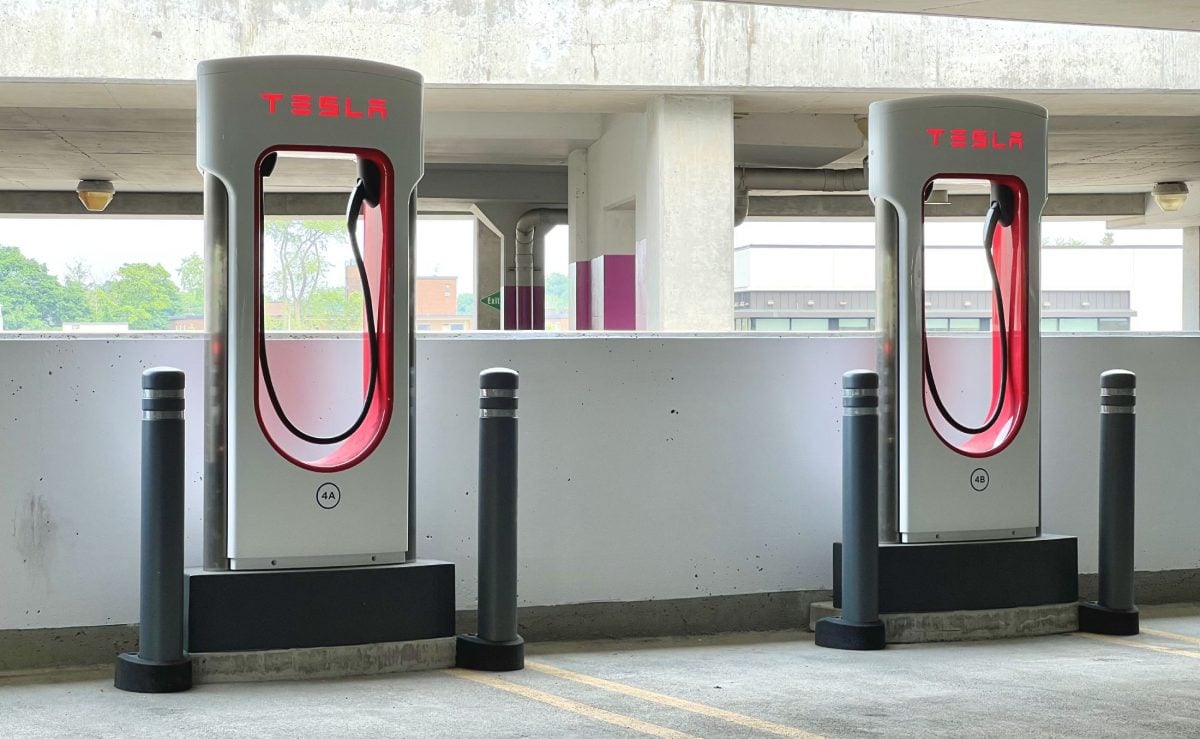
These locations definitely have major limitations. Although 150 kW sounds alright on the surface, adjacent charging posts are linked together and share power. Units labelled 1A and 1B, for example, are linked together. If two cars plug in next to each other, there is a high probability that they will only see 75 kW each. This will kill your road trip progress very quickly. When arriving to a V2, try to find empty spaces to stagger parking.
The older V2 hardware is also incapable of supporting non-Teslas. Even if a CCS EV is connected via an adapter, the V2 locations are unable to communicate and charge those cars. For these reasons, V2 sites are gradually being upgraded to V3.5 and beyond.
Urban Superchargers
These lower power Urban sites are less visible in public, unless you know where to look. While only delivering up to 72 kW, there is a great use case for low power DC fast charging. Many shopping malls, restaurants, and parking garages like to host Urban Superchargers because it helps drive business to their location. At 72 kW, you have about an hour of dwell time for your EV to get recharged. Normal Superchargers are better for road trips, and Urban locations are perfect for short term parking.
Unfortunately, we haven’t seen any Urban Superchargers that are open to other brands. It may be a technical limitation, like with the V2s.
V3 Supercharger
The version 3 locations came online around 2019. It was a critical time for Tesla as they were launching their mainstream Model 3 sedan. V3s are capable of delivering up to 250 kW, and more importantly, power splitting is a much smaller concern. You can charge two EVs next to each other, and they will most likely receive all the power they request.
The cable was also a big upgrade on V3s. It’s much thinner and easier to handle (especially in colder temperatures), and being liquid cooled helps maintain high amperage charging for longer, before overheating arises.
The V3 Superchargers are also the first version that is capable of charging non-Tesla EVs. Most non-Teslas are still outfitted with CCS1 ports, so an adapter will most likely be required. And NOT all locations are enabled for non-Tesla access. Please check the Tesla app or your vehicle navigation to find compatible locations. Tesla still reserves some locations for exclusive Tesla access. So plan ahead instead of showing up to any random Supercharger.
Magic Dock Superchargers
These “Magic Dock” locations are really neat because they have built-in CCS1 adapters. These posts usually look like regular V3 locations, but they have much larger holsters to house the adapter. Although, some V4-looking posts also sometimes integrate the adapter docks.
All Magic Dock locations will work with any EV that is capable of communicating and charging on CCS1. Every other type of Supercharger in this list requires the EV manufacturer to partner with Tesla and upgrade software until their cars are allowed on the network. But Magic Docks really are open to all vehicles. These locations, however, are not very common.
V3.5 Superchargers
The V3.5, or sometimes called V3+, look strikingly different from earlier versions. Now we see the taller and slimmer charging posts with longer cables. The longer cables are a really big deal for drivers of non-Tesla EVs because of mixed charging port locations. The problem with charging non-Teslas on V3 site is that cables are often to short to reach charging ports when parked properly. So many Ford, GM, and Hyundai drivers need to occupy more than one space.
These are called V3.5 because although they have the new and improved charging post design, they still use V3 charging cabinets and electronics. But the improved posts allow Tesla to increase power output from 250 to 325 kW. Many of these locations are open to non-Teslas.
V4 Superchargers
The latest and the best technology, but not broadly available just yet. The true “V4” locations combine the new V4 posts with upgraded power electronics in the cabinets. Power output is increased all the way to 500 kW.
Up until V4, all prior versions were relatively “lower voltage” operating at up to 500 volts. While this is fine for most Teslas and light passenger vehicles, larger trucks and high performance EVs benefit from a higher voltage architecture. So the new V4 locations can charge EV at up to 1,000 volts. The benefit of operating at a higher voltage is reducing current, and therefore reducing heat.
EVs with higher voltage architectures like the Cybertruck and EVs from Porsche, Hyundai, and Lucid will be able to charge at much faster sustained rates on V4 locations. The existing Tesla model line up with S,X, 3, & Y are still only see 250 kW.
Considering buying a Tesla? Use our referral link to get 3 free months of FSD, and help support our content.Add EVchargerReviews to your Google AI Overviews Sources: