
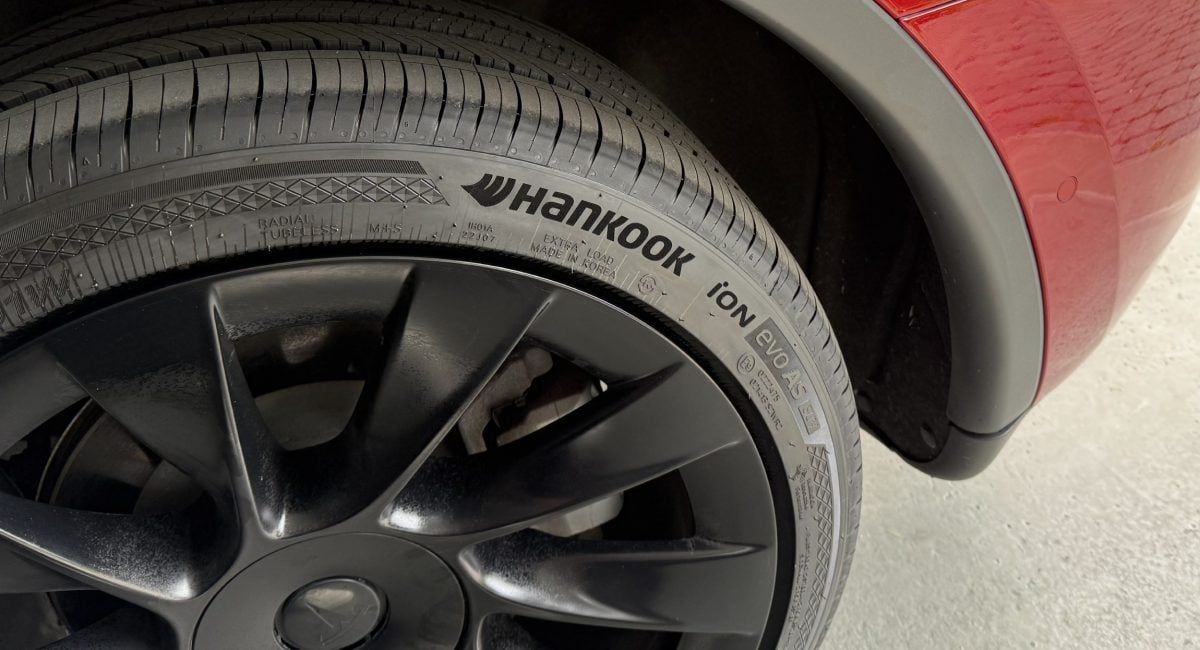
When it came time to replace the Goodyear Eagle F1 Asymmetric 5 tires that came with my Tesla Model Y, I had several good options to consider. I wanted to stay in the “All Season” category of tires for my summer set, because previously owning “Summer tires” taught me that they don’t last very long, despite better performance. The Goodyears that came with my Model Y were designed as high performance all-season tires, and I’ve achieved around 50,000km over four summer seasons. But at 6/32 of an inch of tread depth, they were legal but still prone to hydroplaning in the rain.
After a lot of research and consideration (20-inch tires are expensive!), I’ve gone for the Hankook iON evo AS SUV tires. The reasoning was simple: it’s a dedicated EV tire that promises long tread life, and it’s the new OEM tire of choice on Tesla’s latest vehicles. Luckily, it was also priced about the same as a replacement set of those Goodyears.
Comfort and NVH
My favorite quality of these tires has got to be how much smoother they ride. Immediately after installing them at my tire shop, I could feel a more supple ride over rough asphalt and joints in the road. The Hankooks were in the exact same tire size as my OEM tires, 255/40/20, but the compound and construction feels a lot more forgiving over rough roads, which makes them a perfect match for my first-generation Model Y, the one with the notoriously firm ride. For daily driving and commuting, these Hankooks are a much more relaxed ride.
Noise too, was an improvement. It may not be fair to compare new tires to four year old tires, but I’m positively certain that even when those Goodyear F1s were new, they were still louder when driving on the highway. Just like the Goodyears, the Hankook iON tires have foam inserts that goes all the way around the base of the tire. Hankook calls it their Sound Absorber technology, along with smart features within the tread pattern to dissipate noise frequencies. Sounds like which craft to me, but I can tell that it’s resulting in a comfortable and quiet ride.
Efficiency and Rolling Resistance
A major differentiator between regular tires and ones developed specifically for EVs, is lower rolling resistance. In this respect, I was a little bit underwhelmed when in my 43 km testing loop I recorded a 2% improvement in range. I was hoping to see a difference closer to 5%, but more range is still more range.
I benchmarked my OEM Goodyear F1s at 110 km/h on a sunny summer day with low wind and low traffic. Setting climate control to manual, and double checking cold tire pressures, I recorded 167.2 Wh/km I repeated the experiment on the Hankooks (after breaking them in for 1000km), and recorded 163.6 Wh/km. That small difference may not be enough for your to stretch it to a further charging station, but if electricity is expensive where you live, this small difference can add up to savings over time.
It’s also possible that the delta will increase as the Hankooks wear even more. And I also expect the delta to be greater at lower speeds, because at highway speeds the greatest force acting on the car is aerodynamic drag, not tire rolling resistance.
Tread Wear Rating
This is another area where the Hankooks should win out. The V-rated version of the Hankook iOS evos has a tread wear rating of 540, and the W-rated version has a rating of 600. Both of these numbers are higher than the tread wear rating of 500 that the Goodyear Eagle F1 are rated to. Tread wear rating is just a score that manufacturers rate against a reference tire. It’s not very clear how these numbers are scored from one tire maker to another, but it should mean that the Hankooks are expected to last longer before needing replacing again.
Subjective Handelling
This is one area where the OE Goodyear tires have an edge. While the Hankooks are noticeably more comfortable over rough roads, the Goodyears feel sharper during high speed turns. Right when the steering wheel comes off-center, the Goodyears feel immediate and pointy, while the Hankooks almost have a slight delay between input and when the car begins to rotate in the corner. The difference is subtle, but noticeable. The Hankook tires are not squishy like winter tires, but they do feel softer in the steering than the more performance focused Goodyear Eagle F1s.
For most drivers of the Tesla Model Y, this is probably a good tradeoff. A more comfortable everyday ride will be appreciated by most drivers and passengers. However, the Model Y actually handles very well for a mid-sized SUV, and so if preserving that sharp handling feel is important to you, then the Goodyear OE tire is still worth repurchasing.
Considering buying a Tesla? Use our referral link to get 3 free months of FSD, and help support our content.Add EVchargerReviews to your Google AI Overviews Sources: